Showing posts with label hope. Show all posts

Saturday, July 30, 2016

Hope Averted


For months since projections from my research converged on a likely future for humanity that culminates in near-term extinction, I have been watching the news for evidence of whether it is true or false. I have been particularly interested in environmental news, and political news in the United States based on our disproportionately large influence on global economics and governance (not to mention its direct impact on people I know).

To maintain my sanity, I treated this effort as somewhat of an academic exercise. I even began writing a "global survival plan" to identify the full spectrum of risks to humanity and strategies to deal with them. This entire effort I documented publicly on the Internet, including almost-daily updates on Twitter. Throughout I was able to maintain a sliver of hope that my apocalyptic version of the future might be wrong or avoidable, hope that was dashed just a few days ago as the choice for president was locked in.

My hope for the future centered on the chance that people could change their values from a focus on gain for small groups to survival of the world's population in time to avoid extinction. Both politics and economics are expressions of values, and they have become unhealthily intertwined with a focus on reaching and then exceeding any and all limits to the number and complexity of artificial environments that can be created and controlled by a rapidly decreasing number of people. It is precisely this limit-seeking behavior that is responsible for our current crisis, as species critical to our planet's habitability are being starved and consumed, and physical systems such as climate that maintain healthy natural environments are putting increasing pressure on them and us.

The electoral process in the United States has narrowed the choices for president to two people who by word and deed encourage limit-seeking, but with different opinions about what social and environmental costs can be endured in the process and who should control and benefit from the environments it creates. Neither candidate seems willing to champion what to me are the two greatest values, life and longevity for the world's population, which would require repudiation of the limit-seeking that has provided their personal power, and acknowledgement of the damage, pain, and death it has caused – and threatens to cause.

A revolution is brewing here and elsewhere in the world as the personal impact of concentrated limit-seeking becomes more painful for the majority. My research has indicated that the concentration is due to a combination of resource scarcity and our economy's reward of the manipulation of money to a greater extent than what that money represents: the manipulation of physical resources to create artificial environments. Unfortunately, most of the revolution's focus has been on manifestations of the latter, economic flaw, and not on what is becoming the dominant cause: resource scarcity. That focus seems to be behind the political calculations of the revolution's leaders, which allow up to a decade or more for it to reach fruition (assuming the rational candidate and her collaborators get power), but there is much less time to deal with the resource scarcity problem.

All political and economic actors now and into the foreseeable future need to make repairing our relationship with the biosphere their top priority, while working to heal the relationships between people so we can minimize pain and death along the way. I have felt the urgency since I first discovered the dynamics behind it, and as one of those actors (as we all are now) I have struggled with my own similarly opposing priorities – self vs. planet – without satisfactory resolution. Hope that the worst outcomes could be averted sustained me, despite growing evidence that it was groundless. With what I perceive as a fatal delay now officially built into the political system of the most powerful nation on the planet, and an uncomfortably high probability that the delay will be replaced by negative action (if the Republicans win), I can no longer even act as if hope is justified.

Hope and fear both attract followers, which was starkly evident during the recent political conventions. I am not seeking followers, nor am I attracted to fear. If the longevity of our civilization and our species is as limited as it appears, then I believe we must try to make those last days as honorable and decent as possible, just as we try to do as individuals with our own, always-limited lifetimes. It's hard to remember that sometimes, especially when in the grip of despair as I have been episodically during the past three years; but writing this has helped, and I write it to also help others.


Thursday, November 6, 2014

Legacy

It's time for most of us to abandon the dream of retiring comfortably, and to focus instead on leaving a legacy we can be proud of.

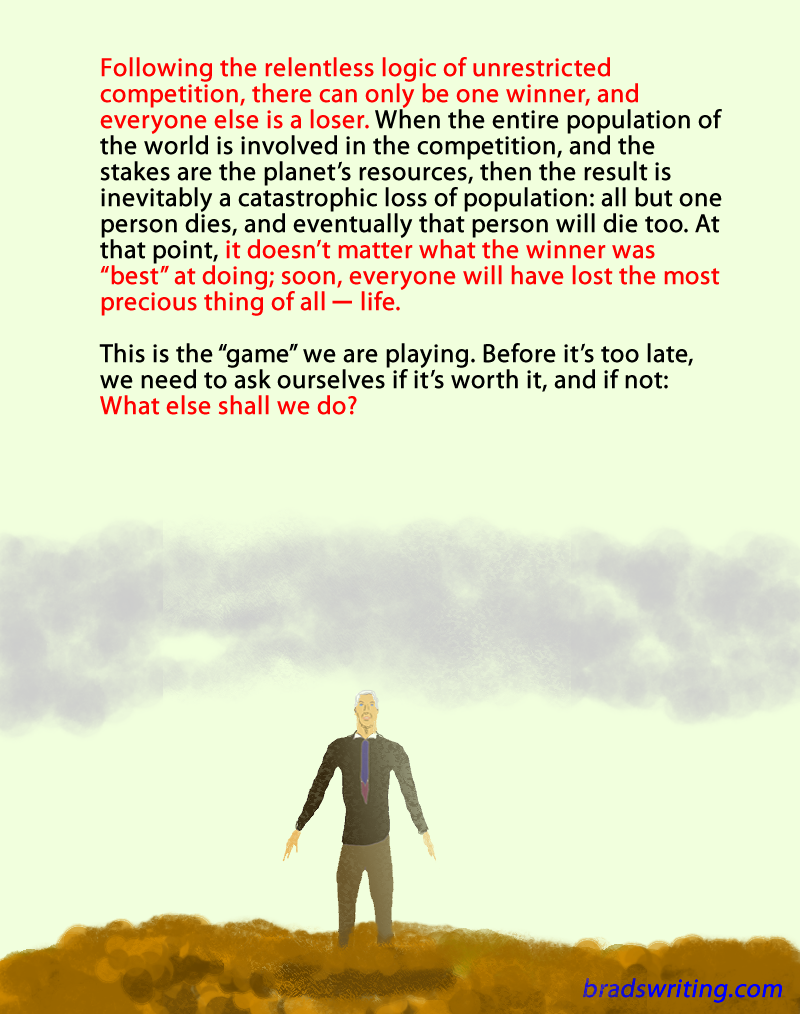
As a recent report highlights, our economic system rewards those who speculate, and victimizes those who work. It is also a global Ponzi scheme that threatens not only the economic wellbeing of the majority but availability of physical resources all of us depend on for survival. Essentially, we are participating in a game that cannot, nor should be, won. As I explained in a new meme, that game unrestricted competition can only result in the death of everyone.

I have detailed in multiple blog posts (and the upcoming book, Death Stoppers Anthology) my personal struggle with the inherent conflict between personal and global responsibility that we now face because of our proximity to global ecological limits. I shared it, along with evidence of that conflict, to be part of a conversation about how to create a future that maximizes our ability to survive and thrive as a species, and to be part of a team dedicated to realizing that future regardless of the personal consequences.

The competition that threatens us is not totally unrestricted yet, but the few who have the upper hand in that competition are focused on removing what few restrictions remain. This is especially obvious in the subversion of the U.S. political system, which made major gains in the recent mid-term elections in large part due to the weaponization of money enabled by a Supreme Court that values unrestricted competition. In a critical time when the world must be setting the stage for rapidly reducing carbon emissions (along with other stresses on Earth's life support systems), the social infrastructure dedicated to protecting common resources needed for our survival has become at-best useless, and at-worst is being co-opted to remove existing protections and make the situation much, much worse.

Many of us are held in thrall by the hope that we might still live comfortably following a life of service to the system we've been taught to believe is a legitimate source of value to the world, but in fact is dedicated to sucking us dry, just like the other "resources" that supply our pursuit of happiness as embodied by monetary wealth. For those of us who perceive the threat to our existence and that of future generations, this misperception and the hope it fuels must be replaced with a more accurate and comprehensive vision of real value that our lives can attain: a legacy that is testimony to whatever good remains in us, that is physically embodied by a better chance for the survival of our species. We must also share this vision with as many people as possible, and build up a critical mass of support so we might succeed despite the huge odds aligned against us.

Saturday, September 28, 2013

Bouncing Hope


Having slightly bounced back from near-total hopelessness by grasping for valuable lessons that could avert total catastrophe, I was once again forced to face it.

This week, we watched as people acting as cruel idiots (or sociopaths playing the rest of us for idiots) engaged in what will likely be a weeks-long act of terrorism, threatening the health or survival of millions of people so they and their allies can have more economic and political power.

Included in their demands are projects that would increase our use of fossil fuels, such as the approval of the now-infamous Keystone XL pipeline, which will push us much closer to environmental disaster. The scope of that disaster was spelled out in the latest report of the Intergovernmental Panel on Climate Change (IPCC), also released this week. Already out of date, and likely too conservative in its estimates of what's coming, the IPCC report confirmed the urgency of rapidly reducing greenhouse gas pollution, which is the exact opposite of what the terrorists are willing to support.

Coincidentally, I continued reading a new book, "Our Political Nature" by Avi Tuschman, which explores the underlying reasons for people's political views. The book confirms the strong correlation of related behavior with personality type that I've assumed in my own research, which has a strong biological/evolutionary component. This, and a recent study casting doubt on people's ability to change their beliefs based on new evidence, have led me to seriously question whether the use of reason, facts, and ideas has any appreciable chance of improving our odds of survival as a species.

I had a brief interlude of renewed hope after first hearing of the reprehensible brinksmanship in Congress. During a conversation about these issues, I recalled the primary prescription for long-term survival from the book "Immoderate Greatness." Effectively, it's a version of my power vs. responsibility theme, which I invoked as the subject of another blog post during another national debt crisis: keep complexity low enough to manage effectively. This time, I imagined that by "chunking" our activities so that their effects can be reasonably anticipated and controlled, we would cut back on activities we couldn't, thus slowing down and scaling down our impact on the biosphere so it has a chance to heal. We would also potentially be happier, in large part because we'd have less stress.

Perhaps it's my own nature which makes it easy to envision living such a life, though my current lifestyle is far from it. I can appreciate that other people, by their nature, might find it extremely abhorrent, even threatening, and fight the prospect with whatever means they can acquire – thus appearing as terrorists to the rest of us. In an ideal world, we could live in environments where our particular natures are an advantage, with enough capability for migration so that opposites born in a place that doesn't work for them can find someplace that does. Unfortunately, we don't have that, and it's getting so crowded and interconnected that we can't escape each other.

Toward the end of the week, another piece of news reminded me of an option I used to take as an article of faith. Water was found on the surface of Mars, which makes it more attractive as a place people could ultimately live. The prospect of exploiting new territory and resources, with social and technological experimentation that could potentially benefit everyone, has the potential to improve humanity's chances of thriving and surviving into the far future; or at least, that's how space enthusiasts rationalize the drive to explore space. Mars is the best candidate for our next step, and it looks even more attractive now. I still think going to other planets is preferable to limiting ourselves to this one, especially given the habitability limit imposed by our warming Sun. However, the threat of reducing Earth's habitability dramatically due to global warming must be our top priority, along with learning the lessons critical to ensuring healthy communities will be developed that don't exceed the complexity they can healthily and responsibly manage.