Showing posts with label future. Show all posts

Saturday, August 12, 2023

In Pursuit Of Waste

My latest progress in the pursuit of a simple, objective measure of values has yielded a testable model based on estimated distributions of resources throughout the global population. I’m presenting the model as a set of concepts and simulations for use in discussing and exploring ideas and explanations about the world as I’ve been doing in my first blog, Idea Explorer, and more loosely in my fiction as embodied in the BIOME/Lights Out books and the Simulated News blog.

To the extent that my current simulation is applicable to actual history, I can characterize my lifetime as coinciding with a period of human history when economic activity in the production of waste has had more value than people and is likely to result in the extermination of our species along with many others that are even more undervalued. I have personally pursued waste, which I define as resources that do not meet basic biological needs, and/or they eliminate the ability of others to meet those needs. In particular, I have devoted most of my life to the enabling and development of technology that can acquire and manipulate the world’s resources at an accelerating rate. 

One aspect of the simulated world’s future is rapid production of waste even as the world’s population crashes, which might be explained by the influence of artificially intelligent machines taking the place of humans to serve the purpose of their own continuation as the ultimate embodiment of waste. While I have not directly contributed to that, I have enough experience and knowledge to closely follow it and use some of its precursors in my own work, making such speculation more than an extrapolation of science fiction.

Interest in the role of values in the determination of humanity’s fate has always had an emotional component, alternating between the elation of discovery and the guilt of being part of a global killing machine that enables that discovery. What felt like a binary choice between personal longevity and happiness aided by employment of technology and waste creation, and long term longevity of the biosphere that encompasses and nourishes life, has been largely verified by study and evidence. Hope has driven the search for a third choice that optimizes both, and frustration has accompanied failure in that search. 

Technology as the answer to many of humanity’s wants, fulfilled by waste, has sabotaged our desire for a long future that only a replenishable and diverse habitat can provide. In the terms of the simulation, serving the value of waste ultimately overwhelms the values of habitat and people. By pursuing waste as a default in a culture where personal survival is contingent on it, contribution to the demise of life has been all but inevitable.


Wednesday, July 3, 2019

Transitions

As the citizens of my fictional simulated world "Hikeyay" begin their transition to a healthier life based on the best recommendations of my multi-year effort to model humanity's past and future, I am attempting a transition of my own in a world that is headed in a very different direction.

For more than twenty-five years I have sporadically attempted to identify my own values, related goals, and means for realizing them after mostly disappointing results from studying and trying others. As I near my sixtieth birthday, that attempt is mostly complete, and I don't have much time left to act on the result – the equivalent of Hikeyay's execution of a global strategy to delay extinction as long as possible.

The competing responsibilities I've grappled with for more than a decade and wrote about in Death Stoppers Anthology are still in play. Global responsibility, anchored in humanity's survival and defined by our relationship with the rest of the biosphere, is – I know now – best served by helping other species survive and thrive by decreasing ecological impact, which reverses the drivers of extinction (habitat loss, invasive species, pollution, population, and over-harvesting). Personal responsibility, tied to maximizing individual happiness and longevity, is served by increasing personal ecological impact up to a point (the happiness peak); and is served by decreasing ecological impact if beyond that point. 

My simulations show that a globally significant number of people began passing the happiness peak after 2001, meaning that human pain and death became a consequence of not serving global responsibility. Now two-thirds of the world's population is past the peak, and the rest could be past the peak by 2030 under worst-case (and what I currently consider most likely) conditions if action isn't taken. Even if aggressive action like that contemplated in Hikeyay is taken, any delay would add more casualties and risk that consequences could multiply far beyond what even the most optimistic technologies might be able to manage.

Based on measurable variables like age and wealth, I estimate that I am at least as close to the happiness peak as the world total (a "phase" of 5.7 in the graph below). That matches my subjective experience in the realm of personal responsibility. I have always felt global responsibility, but it has grown exponentially with knowledge of my role in the future and the waning of confidence in the judgment of leaders who claim they know how to make that future better. 

The future is the result of a collaborative effort. Until now, I have chosen to mostly develop and share my own insights with others, look for ways to contribute to a comparable reality, and do what appears right until and unless it shows signs of being the opposite. With the equivalent of a better roadmap for identifying appropriate action, my new transition involves interpreting that map and trying what it suggests. 


Friday, June 29, 2018

The Extinction Test


One of the reasons I became interested in humanity's extinction was because it provides a clear test of whether a set of actions is good or evil. If your actions contribute to extinction, then they are evil (but you aren't). If your actions help avoid it, then they are toward the good end of the spectrum between good and evil. The rationale for this is based on placing the highest value on human life, because without humans there can be no values.

Another reason for my interest was awareness of a non-zero probability that it could happen in my lifetime. While studying the energy crisis as a teenager in 1976, before I ever heard of global warming, I realized that the pursuit of unlimited energy consumption could mean a hothouse-like death if it was confined to our planet, which forced a decision between limiting our consumption or moving it into space. 

Nearly two decades later, after the famous impact of a comet with Jupiter, I prepared a presentation to my local astronomy club on the potential for the impact of a comet or asteroid with Earth, and learned that it was a serious threat to the survival of our species. This was in addition to the long-term inevitability that our planet and all life on it would be exterminated by our Sun warming as part of its natural aging process. Asteroid impacts and solar warming also made the case for at least some people leaving Earth so some of us could survive.

So began my research into the possible ways that humanity could not only avoid extinction, but maximize the number of people over time. This and some happy accidents drew me to the growing movement inside and outside the professional space community to pursue the settlement of Mars. As a founding member of the Mars Society, I promoted that vision while investigating the limits of the ultimate goal: settling the rest of the Universe. 

While trying to estimate how many people could live on another planet, I became familiar with the estimation of how many people could live on this one. Space enthusiasts and environmentalists have long had an adversarial relationship due to a fundamental disagreement about both the existence and acceptability of limits to human activity, and until I began seriously studying the issues I came down on the space enthusiasts' side of that debate. 

Another chance event, my attendance of a lecture by prominent physicist Albert Bartlett on the consequences of exponential growth, especially regarding energy supply and consumption, convinced me that the environmentalists had a point. It wasn't lost on me that I should have seen it myself with years of studying and using both math and physics. 

An update of a famous study relating human behavior to environmental impact provided more detail which I could use to inform my research, and made an even more convincing case that people could conceivably die off, on any settled world such as our own, long before an asteroid impact or solar event did them in.

In 2005 my research became a presentation to the Mars Society, along with a published paper. It concluded with several options:

  1. Change nothing and commit to a minimal population living a brutal life.

  2. Stretch our resources on Earth with a limited population living well until natural disaster strikes. Deflect asteroids to extend that time.

  3. Settle the Solar System and have a large population until the Sun dies.

  4. While settling the Solar System, develop the technology for stellar travel, which may help us outlast the Sun.

After thirteen years of studying ecology, social science, environmental science, and many related subjects, as well as constructing additional mathematical models, I think it's highly probable that extinction is imminent: we have pursued the first option for too long, making it far too optimistic and ruling out the remaining options.

Still, those last two options beckon. My imagination has run wild with ways to yet make them viable, fueled by insights from my latest mathematical model. Exploring those ways and how to make them a reality is why I quit my job, along with realizing that the alternative was a life of failure and despair that would not be worth living.

The Fix timeline is one of those ways. It is a variant of the second option that might help most of us survive for a few decades, if we're lucky, and create a new version of civilization that would be able to responsibly take the next steps: settling other planets. To live for more than short exploration periods on far less habitable worlds than ours, settlers would need to have a basic commitment to sustainability – both physically and socially – with a default respect for all life they encounter since that life would already be adapted to survival in the environment. 

Commitment to sustainability and respect for life would have already been learned as a basic requirement for living on Earth, and may therefore take more than one generation to cultivate before leaving. This points to another way of making a large interplanetary population possible given the short window of opportunity we have to avoid our immediate fate: overwhelming social pressure to enforce the requirements for living in that future world now. The brief amount of time we can live in relative comfort that kills our future selves would be jettisoned like going on a crash diet with the impending absence of food.

While considering the difficulty of these and other ways to save the future, I must remind the reader as well as myself that we are all subject to the extinction test, whether we choose to be or not: assisting the death of our species is the ultimate evil.


Wednesday, May 30, 2018

Reset


It became painfully clear in April that I could no longer live with business as usual. Following my own instincts on a part-time basis while yielding to those of others the rest of the time just wasn't working. A constant barrage of news that made the stress of awaiting terrorist attacks after 9/11/2001 feel like a lazy day at the park was also a factor. The trigger for acting to change it, though, was the result of upgrades to my Timelines model which I had tailored to reflect how multiple variables changed within the world's population over most of civilization's history based on identification of what was likely causing those changes. The model confirmed with more than 80% confidence that there is, at most, a two-year window to reduce the chance of humanity's population from suffering a major decline that could likely lead to our extinction in twenty years. I had a moral obligation to use what I'd learned to take maximum advantage of that window.

I quit my job and worked full time on figuring out the next steps, among them how I could collaborate with others committed to the same cause and develop resources to continue. The first step was obvious: rolling out the new version of the model as a starting point for discussion. I was under no preconception that what I had was ideal, nor fully tested, but it was good enough to reproduce the problem in sufficient detail to identify potential fixes. As I started the rollout, I discovered with the advantage of full-time effort a few minor bugs in the model, and fixing them suggested other modifications that made it more robust than before. I also decided to investigate historical context which might provide guidance in interpreting (and further testing) the numbers in terms of actual experience; and its earliest insights helped outline the first narrative in the rollout. 

Meanwhile, I was sucked back into the Rabbit Hole. The minimal progress made on various environmental, economic, and social fronts by the last U.S. administration while being obstructed at every turn by its political opposition has been aggressively reversed, and the goals guiding that progress – which I interpret to include increasing decency, fairness, health, and safety for all – have become harder to reach. In response to this I felt also compelled by moral obligation, but on a more visceral level. 

As the youngest student during most of my school years I was terrorized by bullies and developed an almost autonomic reflex to stand up to them and fight if necessary. That reflex has been activated more times than I can count since November of 2016, but social norms and a deep pride in personal decency have immensely limited its expression, mostly on social media, where recently my self-control has waned in proportion the magnitude and frequency of assaults on what – and who – I consider good. Calling out bad behavior can only go so far in stopping it; like the bullies I faced in school, its protagonists may need more solid resistance.

One of my favorite T.V. shows of all time is Star Trek (the original series). Its design as a set of morality plays often showcased innovative, if sometimes imperfect, conflict resolution. The characters on each side of a conflict had eventually-identifiable motivations, capabilities, and weaknesses, just as people do in reality. Changing motivation was a typical first option: find common needs and wants, and discover a way for both sides to get them (or at least not lose them) without fighting. Identifying the others' weaknesses and developing a strategy to exploit them was another option, employed when the first option looked like it might fail. A third option was to assess or develop capabilities that could be used to minimize the damage from confrontation or avoid it altogether (even if one or both sides wanted it). Key to success in any of these strategies was understanding and eventual respect by at least one side of any potential conflict. That those lessons still resonate fifty years after I was first introduced to them is both a testimony to great storytelling – one of the reasons I'm attracted to writing fiction – and their universal applicability to human (or human-like) relations.

Understanding and respect are never a given; they must be developed because of their dependence on the specifics of each situation. That work requires motivation, which is tied into the determination of whether conflict or cooperation (absence or resolution of conflict) will be the main dynamic between two parties. If one side's motivation is limited to dominating or destroying the other side and it is capable of doing so (including prohibiting escape), then conflict is inevitable and somebody is going to get hurt or dead as a result. People who have a hard time believing that there is anyone who can't be reasoned with may try to avoid that possibility by putting extra effort into their own understanding and respect, inviting the risk of losing a conflict already in progress.

In the U.S. there there have been multiple conflicts in progress during most of my life, with the sides easy to spot. As a child in the Washington D.C. area during the 1960s I saw riots in the streets and news stories on T.V. about self-identified groups of people with economic and social power hoarding it to the detriment of those they didn't identify with, and fighting or instigating wars to preserve the ability to do so. As has been the case in other countries, religion was used to both define some of those groups and justify their actions based on questionable history, and even more questionable understanding of cause-and-effect. There was also a conflict we are all involved in, between humanity and Earth's other species, with the most horrific of consequences for us and them if we "win": extinction.

My personal efforts at understanding simply reinforce that last observation, which has been known for decades but not believed by most people. It is still hard for me to believe, though intellectually I consider it a certainty. As a member of a "can-do" culture that holds unlimited growth to be a supreme value, and someone who spent most of his life believing (and being nurtured by others with the same belief) in an exclusively omnipotent being that un-verifiably promises an afterlife if we just worship it/Him, the idea that ultimate winning causes ultimate loss is overwhelming. It also calls into serious question a vast network of interrelated beliefs that would render it untrue, and that form a basis for the identity of many groups that view themselves as superior to other people and other species so that they can have a clear conscience as they take what the others have.

In a way, I see the battle between reality and voluntary delusion being played out in the news these days as akin to how a person might react to a diagnosis of an unintentionally self-inflicted terminal illness, and a long-shot, painful course of treatment that would only delay death by a short amount. That person could choose to be in a state of denial like that many are in now, hanging onto the idea of doing what they're doing until it is unquestionably proven fatal by the end result. Accepting responsibility for the illness a more psychologically challenging alternative, with all the issues and feelings it brings up (such as winning as the cause of loss). Accepting the existence of the illness and blaming others for it is yet another option, which is a very real possibility for some of the people in the real world this analogy represents, especially the poorest and least powerful among us (including children) who are as close as any of us to being clear victims. The decision about whether to take the long-shot treatment hinges on which of these reactions is chosen, with denial being the one that definitely will not lead to treatment.

As someone who values both truth and life, I choose to fight for both while realizing that it is very likely too late to make a difference in the outcome. The necessary is worth doing, even if it is impossible.


Wednesday, December 14, 2016

Loss and Resolve


Recent events in the Arctic have confirmed that global warming is self-sustaining, which along with accelerated extinction rates and other news has led me to believe that my worst-case projections of future global trends are likely correct. For several months I attempted to create a global survival plan that mapped out this and other threats to humanity and what we might do to confront them, but the results of this year's U.S. election, especially at the national level, appears to have nullified even a remote possibility of enacting such a plan and saving our species from extinction in the very near term.

It is small consolation that I did what I thought I could to fight against this outcome even as my research exposed that it is an inevitable consequence of our nature. Loss of hope had not squashed my lack of acceptance as I made a case for delaying the outcome for as long as possible; but at least in this country there was just too large a fraction of the population that either didn't care, or wasn't even paying attention to basic facts that belied their beliefs (including the obvious clues about the evil they were about to unleash).

I zeroed in on what I could personally control by enacting a plan to cut back on my own contribution to the drive toward oblivion: paying off credit, developing ways to scale back on my ecological footprint, and exposing through writing how people in a healthy world might live, as compared to our own dying world. It remains a fact that although it may soon be more possible for people to exceed limits of planetary habitability, we don't have to act on it. More specifically: if they drill for more oil, we can still avoid buying it. If more jobs become available in what I think of as the planet-killing sector of the economy, we can refuse to take those jobs. As protections are removed from our food, drugs, and financial industry, then we are justified in not trusting them, and seeking more reliable and responsible means to survive. I understand that "we" are likely a very small part of the world economy, but at least we can have clear consciences by contributing less to its death.

In a way I feel very sorry for the decent people who voted for the acceleration of our global nightmare. Many just want better jobs, or recovery of jobs they and their friends have lost. If we lived in the world of a century ago, which presumably is when America was "great," the costs of stripping away restrictions to growth would have been bearable, and the horrific outcome we now face would have been perhaps decades in the future (giving them enough time to live out their lives, even as the loss of future lives was ensured). I personally know a few of them, and it's not lost on me that for most of my life I had a lot in common with them.

My father remains my personal hero, and he was one of the most conservative people I've ever known. I don't know if we would be at odds with each other if he were still alive; but I do know he would have respected the results of scientific research, and perhaps would have tried, as I did, to derive his own understanding of what's happening. A child of the Great Depression, and a combatant in the world war that challenged the great fascists of the last century who are emulated by the new leaders of today, he would have at least recognized that threat, and challenged me – as he often did – to be "not just a man, but a hell of a man," and stand up for what's right as I see it. The great war of this century may already be lost; but those of us with honor and the vision to recognize it must try to delay that outcome for as long as possible.


Sunday, November 6, 2016

Voting In a Different World


Those who wish to "make America great again" seem unable or unwilling to accept that the United States and the world it inhabits are irreversibly different from anything they might identify as "the good old days," and that trying to force change in that direction will cause death on a massive scale that ensures its impossibility. By selling that goal and policies that would promote it, Donald Trump has proven himself a menace to the country he is campaigning to serve (regardless of whether he intends to really "serve" – or rule).

As I discussed back in July, both presidential candidates support the behaviors most responsible for the existential crisis that faces our entire species, with the main difference being mainly in degree. Trump would accelerate the destruction of natural ecosystems that enable us to live, without acknowledging it is even a problem; while Clinton is willing to at least admit there is destruction, though seems unwilling to take the drastic steps needed to truly address it (even if she does have a friendly Congress).

I share both race and age with many hard-core conservatives who I'm sure support Trump, and for many years I also shared their political opinions and religious beliefs. Experience, and a parent who thrived on innovation and exploration, encouraged me to question everything; and by age 40 l had jettisoned most of those opinions and beliefs in favor of a more general and personally meaningful set, which I have written about extensively.

In retrospect, my evolving views reflected the changes in the world around me – physically, socially, and in terms of an explosion of knowledge and understanding of how everything works. As people became more interdependent, they were forced to face their core values about life, including which lives they would cherish and which could be used and thrown away. Those who valued only a few lives seized as much power as possible for their groups; while the vast majority who valued other lives as much as their own supported sharing power with other groups and, to a growing extent, other species.

Meanwhile, humanity's activity – aided by technology – began having obvious and increasingly serious impacts on quality of life, and predictive technologies used by scientists showed that those impacts were directly traceable to our approach and exceeding of a range of natural limits to the habitability of our planet. I became aware of this, and in my own way verified their predictions with a corresponding change in my worldview that now defines my politics, along with other parts of my life – because knowledge is most valuable when shared and converted into action.

I have shared my insights and attempted to convince those who pay attention that certain actions are critical to improving the future, however bleak that may appear to be. Currently the most critical action is to keep ultraconservatives like Trump from exerting enough power on world affairs to accelerate humanity's race toward extinction. In a few days we will know the impact of voting, and be able to assess whether or not we are in for the worst.

Saturday, July 30, 2016

Hope Averted


For months since projections from my research converged on a likely future for humanity that culminates in near-term extinction, I have been watching the news for evidence of whether it is true or false. I have been particularly interested in environmental news, and political news in the United States based on our disproportionately large influence on global economics and governance (not to mention its direct impact on people I know).

To maintain my sanity, I treated this effort as somewhat of an academic exercise. I even began writing a "global survival plan" to identify the full spectrum of risks to humanity and strategies to deal with them. This entire effort I documented publicly on the Internet, including almost-daily updates on Twitter. Throughout I was able to maintain a sliver of hope that my apocalyptic version of the future might be wrong or avoidable, hope that was dashed just a few days ago as the choice for president was locked in.

My hope for the future centered on the chance that people could change their values from a focus on gain for small groups to survival of the world's population in time to avoid extinction. Both politics and economics are expressions of values, and they have become unhealthily intertwined with a focus on reaching and then exceeding any and all limits to the number and complexity of artificial environments that can be created and controlled by a rapidly decreasing number of people. It is precisely this limit-seeking behavior that is responsible for our current crisis, as species critical to our planet's habitability are being starved and consumed, and physical systems such as climate that maintain healthy natural environments are putting increasing pressure on them and us.

The electoral process in the United States has narrowed the choices for president to two people who by word and deed encourage limit-seeking, but with different opinions about what social and environmental costs can be endured in the process and who should control and benefit from the environments it creates. Neither candidate seems willing to champion what to me are the two greatest values, life and longevity for the world's population, which would require repudiation of the limit-seeking that has provided their personal power, and acknowledgement of the damage, pain, and death it has caused – and threatens to cause.

A revolution is brewing here and elsewhere in the world as the personal impact of concentrated limit-seeking becomes more painful for the majority. My research has indicated that the concentration is due to a combination of resource scarcity and our economy's reward of the manipulation of money to a greater extent than what that money represents: the manipulation of physical resources to create artificial environments. Unfortunately, most of the revolution's focus has been on manifestations of the latter, economic flaw, and not on what is becoming the dominant cause: resource scarcity. That focus seems to be behind the political calculations of the revolution's leaders, which allow up to a decade or more for it to reach fruition (assuming the rational candidate and her collaborators get power), but there is much less time to deal with the resource scarcity problem.

All political and economic actors now and into the foreseeable future need to make repairing our relationship with the biosphere their top priority, while working to heal the relationships between people so we can minimize pain and death along the way. I have felt the urgency since I first discovered the dynamics behind it, and as one of those actors (as we all are now) I have struggled with my own similarly opposing priorities – self vs. planet – without satisfactory resolution. Hope that the worst outcomes could be averted sustained me, despite growing evidence that it was groundless. With what I perceive as a fatal delay now officially built into the political system of the most powerful nation on the planet, and an uncomfortably high probability that the delay will be replaced by negative action (if the Republicans win), I can no longer even act as if hope is justified.

Hope and fear both attract followers, which was starkly evident during the recent political conventions. I am not seeking followers, nor am I attracted to fear. If the longevity of our civilization and our species is as limited as it appears, then I believe we must try to make those last days as honorable and decent as possible, just as we try to do as individuals with our own, always-limited lifetimes. It's hard to remember that sometimes, especially when in the grip of despair as I have been episodically during the past three years; but writing this has helped, and I write it to also help others.


Sunday, November 29, 2015

Discretionary Time


I have accumulated and discarded a lot of stuff during my nearly fifty-six years. It is a pattern that I attribute to shifting goals, needs, and dreams about what I might do with the rest of my life. While some of it has had sentimental and entertainment value, the vast majority – including a large library of books – have been viewed as tools: tools for meeting basic needs such as shelter; tools for learning and exploration; tools for creating things; and tools for communicating with others.

With likely no more than thirty years of life left, I feel the need to seriously evaluate what I can and should accomplish during that time, and to manage my stuff accordingly, especially since I don't expect to ever retire. This means, for one thing, strongly resisting the urge to buy impulsively, and to avoid influences that make it feel like a duty – such as the armada of advertisements and pervasive social cues that accompany the annual Season of Gluttony that (at least here in the U.S.) is more aligned with its historical origin in Saturnalia than the celebration of the birth of hope for salvation and universal love (Christmas) that has formally defined it.

Thirty years seems like a lot of time, but only about five of them (one-sixth, or four hours per day) are discretionary – that is, not used for sleep, eating, working, and related activities. Discretionary time, and the stuff used during it, can be split up among many activities, such as maintaining relationships with family and friends, housework, entertainment, and personal development such as education and hobbies. If we're lucky enough to be able to do what we want for work, up to ten years can be added to this category.

Much of the "stuff" I've acquired for personal development is more suited to what is normally considered "work" than what many would consider "discretionary." Creating has always been more fun than consuming, and I enjoy looking for what I think of as the hidden picture in the "jigsaw puzzle of life," a collaborative understanding of the past and future of humanity along with its environment and values. I don't pretend to have any more special insights than anyone else, but I feel an obligation to do my part, which includes communicating the parts that I see uniquely, helping others share the unique parts that they see, and making a case for my preferences in deciding the future. My stuff of choice, not surprisingly, includes aids to learning and communicating.

Over the past thirty years I came to understand that the current configuration of the puzzle has some serious flaws that need to be corrected soon in order to decrease the chance of horrific global casualties over the next thirty years and beyond. This has made my feeling of obligation even more urgent than what was already triggered by advancing age. In my blogs and books, I've shared my curiosity, my insights, and ideas that might inspire creative thought and exploration by others that can hasten assembly of the puzzle. Concurrently, I have sought to entertain, and to fictionally represent my research along with some suggestions and warnings based on imaginative extrapolation of behavior, knowledge, and technology.

A civilization like ours that is designed to maximize happiness without regard for longevity (except through continuous acquisition and processing of ecological resources) can be expected to resist any attempts to challenge that design goal and the cultural infrastructure that supports it, even as evidence mounts that the resources it depends upon are dangerously scarce and degraded. Only that which directly and efficiently serves the customization of personal environments will be rewarded. I know this, and yet I cannot, in good conscience (service to the value of life) or by nature, keep from challenging it, even when doing so severely limits options for customizing and maintaining my own environment through work and discretionary activities.

Like many people, the probability of maintaining or increasing my current lifestyle over the next thirty years is low, even if I vigorously support our happiness-based economic paradigm and global conditions don't change the way I think they will. Attempting to do so through art (as I recently rediscovered) has a much, much lower chance of success over that period, especially if it doesn't play to people's hopes and desires for experiences better suited to their wants than their current existence.

Unless we make major changes to our society, living will rapidly get more difficult over the next decades, and I expect discretionary time to practically disappear for all but the ultra-wealthy, even if the demand for it increases exponentially in response. Such a development would make much of the present discussion moot, because my thirty-year planning horizon would likely drop to something closer to ten years, yielding maybe one year of useful discretionary time left. One year interestingly coincides with the amount of time I've calculated we have left before reaching a critical ecological threshold that will make large global casualties practically inevitable, which is less than I (and everyone else) would have available if both work and discretionary time was used to try stopping it.


Thursday, November 6, 2014

Legacy

It's time for most of us to abandon the dream of retiring comfortably, and to focus instead on leaving a legacy we can be proud of.

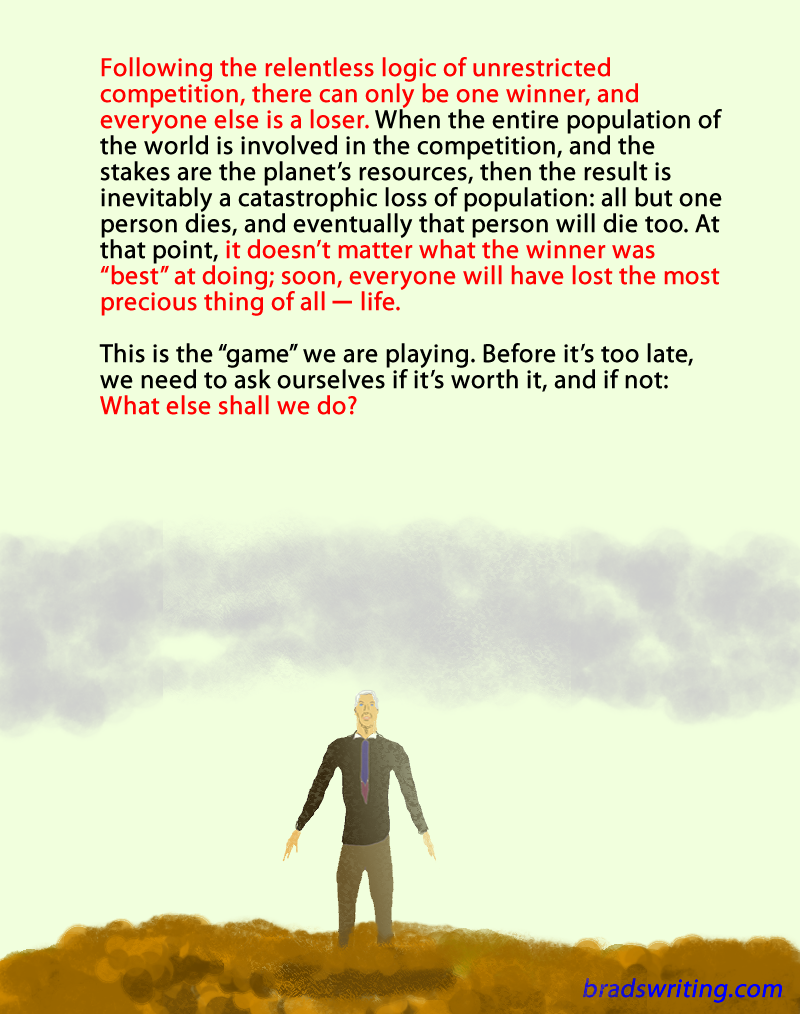
As a recent report highlights, our economic system rewards those who speculate, and victimizes those who work. It is also a global Ponzi scheme that threatens not only the economic wellbeing of the majority but availability of physical resources all of us depend on for survival. Essentially, we are participating in a game that cannot, nor should be, won. As I explained in a new meme, that game unrestricted competition can only result in the death of everyone.

I have detailed in multiple blog posts (and the upcoming book, Death Stoppers Anthology) my personal struggle with the inherent conflict between personal and global responsibility that we now face because of our proximity to global ecological limits. I shared it, along with evidence of that conflict, to be part of a conversation about how to create a future that maximizes our ability to survive and thrive as a species, and to be part of a team dedicated to realizing that future regardless of the personal consequences.

The competition that threatens us is not totally unrestricted yet, but the few who have the upper hand in that competition are focused on removing what few restrictions remain. This is especially obvious in the subversion of the U.S. political system, which made major gains in the recent mid-term elections in large part due to the weaponization of money enabled by a Supreme Court that values unrestricted competition. In a critical time when the world must be setting the stage for rapidly reducing carbon emissions (along with other stresses on Earth's life support systems), the social infrastructure dedicated to protecting common resources needed for our survival has become at-best useless, and at-worst is being co-opted to remove existing protections and make the situation much, much worse.

Many of us are held in thrall by the hope that we might still live comfortably following a life of service to the system we've been taught to believe is a legitimate source of value to the world, but in fact is dedicated to sucking us dry, just like the other "resources" that supply our pursuit of happiness as embodied by monetary wealth. For those of us who perceive the threat to our existence and that of future generations, this misperception and the hope it fuels must be replaced with a more accurate and comprehensive vision of real value that our lives can attain: a legacy that is testimony to whatever good remains in us, that is physically embodied by a better chance for the survival of our species. We must also share this vision with as many people as possible, and build up a critical mass of support so we might succeed despite the huge odds aligned against us.

Tuesday, April 22, 2014

The Real "Universe X"


Since February I have been writing what could be classified as micro-science fiction: "news" stories that I collectively call Universe X. The project started as a way to help me keep my sanity in the face of a barrage of depressing news and soul-crushing predictions about the near-future. I basically wrote the kind of news I wanted to see, as experienced in worlds very similar to our own. Each post was from a unique parallel universe (the "X" in the title), with its own history, and typically about something I considered very important at the time.

As I continued writing, Universe X became more: a vehicle for sharing ideas about how to fix the problems it reported. In my fictional worlds, solutions are often implemented, or about to be implemented, with mostly positive results (though there have so far been a couple of deviations, more in line with what I see as our likely future). As you might expect if you've read my other work, there is a strong environmental component to many of the problems, along with their attendant social impacts. In some universes, the solutions are draconian, imposed by governments or sanctioned international organizations; in others, they are social movements organically responding to imminent or existing problems. As a scientist, it's tempting for me to hope that new knowledge will change the way people look at the world, and prompt them to make it better; thus "discoveries" are made in some universes, and that hope is realized (or about to be).

Universe X has a unifying backstory that ties the posts together, with both a fiction and a non-fiction component. I won't reveal the fiction component here; it will continue to gradually present itself in the posts, and possibly a more complete treatment such as a novel. The non-fiction component, however, is embodied in my ongoing research into what drives humanity's future, which is fully exposed on my research Web site: the "universes" may be loosely interpreted as connected, alternative "worlds," and the snapshots provided by the posts are glimpses into some of the worlds not too far away from ours in time.

Monday, December 2, 2013

Five Roles


For several years I've tried to occupy five roles simultaneously, with mixed results. Priorities have shifted, along with the effort required to maintain them and the dynamics of synergies and conflicts between them. Recently I crossed a major threshold in juggling my roles, which in retrospect was inevitable, and may also be inevitable for like-minded people who have chosen similar ones.

The first role I've occupied is as a husband and supportive member of a small community that includes my family and friends. In my second role, I've been a citizen of the United States, working to make a decent living as defined by my culture, with the hope of eventually retiring comfortably. In the third role, I've been an aspiring artist, creating artificial experiences that might inspire, entertain, and educate others as they did for me. My fourth role has been as a curious researcher, exploring and sharing how and why the future might unfold for our species over the near and distant future. Finally, in the fifth role, I've tried to become a more responsible citizen of Earth.

The selection of these roles is understandable, given my personality. Using the Big Five model, I am an introvert, explaining why I'm comfortable with very few people and why I'm drawn to the art and professions that involve mostly solitary activity. High agreeableness explains why I typically stick to my culture's dominant script, which corresponds in general to the expectations of the people around me. Strong conscientiousness and openness underlie my search for meaning and understanding of how the world works so that, when a goal is set, the supporting actions can be derived and followed. I also have high neuroticism, which motivates me to find and solve problems, and minimize harm resulting from anything I do (or anyone else does) through acceptance of responsibility and a pursuit of knowledge that can improve the chances of success.

I've shared in much of my writing how I've found the fifth role of responsible Earth citizen problematic, especially in light of the results of my research into variables affecting our future. In a nutshell, it almost directly opposes my second role as a citizen of my culture and the goals it prescribes. As evidence has mounted that we may all be doomed no matter what we do, the advantages of following my culture's lead have become harder and harder to see. This made my third role as an artist a lot more attractive as a replacement, even though it almost certainly meant much less short-term income.

Until today, the most recent real-world manifestation of my second role was a job as (effectively) a test engineer, which coincidentally benefited from the other aspects of my personality – at least for a while. My discomfort with the potential for hidden problems, when indulged, is both an advantage and a curse. The advantage is that my heightened sensitivity leads me to problems others wouldn't think of finding. The curse is that I start finding those problems everywhere. Each of us seems to have a limit to how much of that kind of knowledge we can handle, or choose to handle, likely related to the openness personality dimension. My tolerance seems to be higher than most, which sometimes gets me into trouble if I'm not judicious about how I share the "excess," either literally or as a result of being too obvious in my pursuit of it (which in a perverse way can be perceived as "waste"). As I approached my own limit over the course of the last few months, with the fate of the world revealed in news and research overshadowing and adding to my direct experience, it became virtually impossible to do anything but double down and deal with it, all of it. I realized that for the world to become healthier, many of the assumptions behind our physical and social infrastructure would need to change radically, and very soon, making almost all of the things we focused on, in my work and around the world, necessarily obsolete. As a result I became less careful with maintaining perception, to say the least. The consequences were predictable.

My writing had served as a way to deal with both my angst and urge to troubleshoot, before and during that period. Through music, I was also able to access some deep feelings, many – thankfully – positive, a revelation from my subconscious that I could share more than just soul-crushing problems, or numb my pain with the total fantasy painted by TV and movies. I grasped at the possibility that I could transition into a healthier set of roles, using this one to earn enough money to pay off debts and maintain a more basic standard of living as I plotted a course toward more responsible living that didn't sacrifice health and happiness. I did so knowing that my chances were slim, even if we weren't facing a high probability of death by radiation poisoning, climate change, or a horrific combination of both.

I'm still grasping that possibility, and committed now to testing it. Though I'm sure to take some detours along the way as necessity dictates, the future – as I used to say about relationships – is going to be as good as I can make it, and better than it might have been.

Sunday, September 8, 2013

Breaking Addictions


A recent addition to my list of ways I want to live in the future (the "visioning exercise") is having and using the ability to perceive and avoid activities that are unhealthy for me, or through my action, others; especially those activities maintained by addiction.

One clearly unhealthy activity is eating foods that taste good but have little or no nutritive value and contain substances that make us ill. Basically, anything that is sold in a package that can last more than couple of weeks probably fits in that category. Complicating the food situation are allergies, which would affect us no matter how they were found; luckily I have none that I know about – yet. While on my recent diet, I found that tracking what I eat (energy, nutrition) and its consequences (weight, digestive cues) helped. After a few weeks I developed a sense of what was good and what wasn't, and learned to stop eating just as satiation was kicking in. When I ignored that sense, my body let me know almost immediately. The benefit for others from taking this approach was through my stopping financial support of the companies that make the unhealthy foods.

A somewhat less obviously unhealthy addiction is watching TV. I easily get trapped into watching shows that end each episode with a cliffhanger, the best example being "24," which is about to be reborn as a new series. On the surface, it appears that sitting on my couch for several hours at a time harms no one, but there is a kind of opportunity cost associated with it. I could be doing something else that feels better and is generally better for me and others (such as writing), but the need to complete a virtual experience can be too great to overcome – at least until it becomes uncomfortable to continue. The best way I've found to deal with such an activity is to avoid starting it in the first place.

Similar to the TV addiction is compulsively checking the news and social Internet sites. For me, this started in earnest following the 9/11 terrorist attacks, and has become driven by an obsession with present and future threats to the survival of our species and others. This is a healthy addiction where it informs acting on what you find in proportion to everything else in your life. It's unhealthy if it takes so much time that it replaces taking such action or living your own life. Accepting these definitions, it is clearly unhealthy for me. The issues are simply too big; and with any action I take (and I do what I can) unlikely to make a sufficient difference to avoid the worst-case scenarios I naturally tend to focus on preventing, it's all to easy to be driven toward near-paralyzing depression.

After some reflection, I usually give myself the proverbial kick-in-the-pants and stop feeling sorry for myself, then get busy trying to find other ways to make a difference. Some new insights come out of each iteration (which I write about, if they might be useful to someone else), but for me there's the same net result. The simple way out of this unhealthy situation is to do what I've tried with TV: just avoid it. Unfortunately, the effects are too pervasive, and I've lost the ability to totally delude myself or to follow others without question so I can get sucked into accepting their delusions.

There is also the matter of responsibility: to the extent that I'm contributing the problems, I need to stop, otherwise I continue to be partly responsible for them. To the extent that any of my addictions cause bad things to happen, I have an obligation to end those addictions. If I am able to embrace denial, either through self-deception or adopting the perceptions of others, and my subsequent actions cause harm, then I am responsible for that harm just much as if I intended to cause it.

A strong sense of responsibility could be a valuable tool in the fight to stop unhealthy behavior, though evidence shows that it's not enough, even when accompanied by discomfort that comes from taking an addiction too far. It may however be a sufficient motivator to investigate the actual consequences of behaviors, like the tracking I did with my eating. With the knowledge that comes from the tracking, taking action to modify, limit, or eliminate behaviors with negative consequences has its own challenges, especially if you depend on people who don't believe the behavior is unhealthy, or if the behavior meets a set of needs that can't be met in healthier ways; but it can be done.

To summarize: in my experience, responsibility triggers the pursuit of knowledge, which helps identify what actions are healthy and what actions are unhealthy for both us and others. The sense of responsibility, coupled with discomfort associated with unhealthy behavior, improves the chances that we'll take more healthy than unhealthy actions. In my personal attempt to restructure my life by envisioning what I want my future to be like, making healthy behavior dominant is critical. My mental and physical survival depend on it; and if I'm to recover hope that the future world will be healthier instead of sicker, I'll need to work with many others to want the same thing.

Sunday, September 16, 2012

Reconnection


This week marks 20 years since my father, Art Jarvis, died of a heart attack in the middle of a typical day trying to improve the education of kids as the last of many contributions to making the world a better place to live. For years, we spent a lot of our time together discussing issues over a wide spectrum, from the dynamics of our family to math, science, and the lessons he'd learned from a deep and broad background about how society works – and doesn't. Shortly before he died, he paid me the ultimate compliment: that we were alike in the way we thought, except for experience. I've noticed considerable differences since then, but still encounter situations where his wisdom comes to mind, typically in the form of sayings he either learned or created to summarize the core of an issue.

I've been sick at heart lately as my confidence in the salvageability of a livable future slips significantly almost every day. I miss my father more than ever in these challenging times, and wonder what he would say about what's happening and what to do about it. If you'll allow me, let me slip into my fiction writing mode, and channel the part of my father that lives inside me to imagine how a conversation might go between us.

***

BRAD: Hi, Dad. I can't tell you how much I've missed you.

ART: Me too, buddy.

BRAD: A lot's happened since you left.

ART: I'm sure it has.

BRAD: The family's a lot different. For one thing, I got married, if you can believe that.

ART: I figured you might, eventually.

BRAD: I also became an atheist.

ART: Really. How did that happen?

BRAD: After you died, I followed your example. Did a lot of studying, a lot of thinking, and was even fairly active in a couple of churches. Finally I realized that although many of their values made sense, they were man-made: taught by myths but not dependent on them. I dropped the myths, kept the values. Even refined them a little.

ART: What did you come up with?

BRAD: Maximizing life and happiness, first with people, then with other species, with the recognition that we're all interdependent and important.

ART: That's a good summary. It pretty much covers them all.

BRAD: Exactly. It's changed a lot about how I think about things.

ART: I'm sure it has. How's the business going?

BRAD: I had to walk away from it. We tried, we really tried, but it was too much for just the two of us, and then Eleanor had to leave. I had to survive, so I decided to try other things.

ART: What? What are you doing now?

BRAD: Believe it or not, I'm back doing test engineering, and my own writing on the side along with some music. I was also a technical writer for a few years.

ART: Technical writing? We used to do our own...

BRAD: I know, I know. You remember how you used to bitch about how bad help files were for software? I tried doing it better. Can't say I always succeeded, but it beat finding everyone's mistakes for a living, where I got a little too cynical for my own good.

ART: Is it working better for you now?

BRAD: It's complicated. That's what I hoped to talk with you about.

ART: Okay, let's have it.

BRAD: Remember how much fun we had asking questions no one else would ask because they thought the answers were too obvious?

ART: And we found other answers. I was proud of that.

BRAD: I never stopped. I think it's part of my DNA. After you died, I started questioning all of the basic assumptions in my life. The religion thing was a big part of that. I also got a job testing telecom equipment, and found a lot of bugs thanks to what I call my "special skill." I started to find problems outside of work too, especially when I started applying my new value system. Because life is paramount, I got interested in the possibility of Earth being hit by asteroids and comets, and realized that we're all pretty vulnerable to extinction by something too few people are taking seriously. The life test also pointed to the need to settle other planets, to avoid extinction from a warming Sun. I got into promoting Mars exploration as the first step toward dealing with that threat. Then I learned about another threat, far more insidious but just as deadly.

ART: What's that?

BRAD: Humanity is responsible for a mass extinction event, potentially as large as any caused by an asteroid collision. It turns out that other species do a lot to keep the planet habitable, and we're killing them off by stealing or destroying their habitats; polluting the air, water, and soil; and hunting them to extinction. Part of the pollution comes from burning fossil fuels like coal and oil, which is causing heat to be trapped by the atmosphere; that leads to extreme weather such as droughts and mega-storms, melting of glaciers and the polar caps, and release of even more potent methane from permafrost which could amplify the effect by orders of magnitude. The carbon pollution is also acidifying the oceans, threatening the base of the food chain. By the end of this century, we could be all but extinct.

ART: A lot of other people must have figured all that out.

BRAD: The scientific community has done a great job nailing it down. Many have abandoned their normal reticence and are sounding the alarm big time. Unfortunately, the fossil fuel industry and others who depend on them have a stranglehold on the media and several governments, including ours, which is making it all but impossible to do anything meaningful about it before it's too late. I did my own research over the past few years, and it shows what looks like a clear correlation between humanity's impact on ecosystems, the populations of ours and other species, and people's happiness. I'm projecting a peak in world population in about 20 years, and a drop to zero within 60 years. My conclusions align pretty well with those of people who have done a far more thorough job of studying these things.

ART: That's quite a story.

BRAD: I wish it were just that. If I still believed in God, I might be able to delude myself into thinking that a miracle will happen to make everything okay. Unfortunately, as you used to say, "it ain't gonna happen," and the people who think that it will are dragging their feet, making things worse for all of us. Recently, I've been feeling that it's all hopeless.

ART: Remember what I used to tell you about feeling sorry for yourself.

BRAD: Like your dad said, "Run in place until you kick yourself in the ass." I remember.

ART: So what are you doing about it?

BRAD: I took this test job with a non-profit that's building a national network to monitor ecosystems. It's pretty cool, and a way to contribute to the science that can tell us how things are changing.

ART: That's great, son.

BRAD: I'm worried that it won't have any effect on what's happening, though.

ART: Let me guess. With all the information that's already out there, the idiots won't listen. What are the chances they'll pay attention to even more data?

BRAD: They're also enthusiastically trying to destroy ecosystems. They just don't value nature, except as a pile of resources to be exploited. Come to think of it, that's the way they view people too. Remember why I didn't pursue astronomy in school?

ART: Vaguely. I'm afraid I had something to do with that.

BRAD: That was during the '70s energy crisis. I figured it would be irresponsible to focus on what to me felt like mental masturbation while humanity was in danger of burning itself up by pursuing energy just to have more. Later, with the asteroid thing and the understanding of the Sun's future, I realized that science could illuminate what's coming, and how to create a better future, in part by recognizing and confronting threats. I was more interested in using science to explore options than contributing to the science itself, but it was important to know the science first. You showed me that education was key to getting people to even pay attention, and that's part of why I stuck with you on that; the other part, the biggest part, was that I loved working with you.

ART: I suspected that.

BRAD: But now I realize that even education's not enough, just like science isn't enough. Even knowing the options isn't going to solve the problems, or being able to show clear logic leading from cause to effect.

ART: I think you're going off the deep end, there. People just need to be shown...

BRAD: ...How to pursue enlightened self interest. I know you believe that. It was behind everything we did together. Unfortunately, beliefs are far more powerful, particularly when they're shared by one's community. They become part of our identity. When you challenge them, you challenge people's identities. You throw into question the value of all the things they did in support of them. You threaten to devalue their lives.

ART: But if they realize they're wrong, they can find something better. More happiness, to use your term.

BRAD: Not if a large part of their happiness – and the power that enables it – derives from their community. You'll have to convince the whole community, or force them into a situation where the community loses influence over them, like what happened to me after you died. Also, the risk of finding something better is losing what you already have; and it is a risk, because you may not find something better.

ART: That's an interesting theory...

BRAD: You taught me to think for myself, but you had your own value system superimposed on top of that, which because you were so smart, and had so much experience, I didn't really question until you were gone.

ART: Anecdotal evidence.

BRAD: Sometimes that's the most convincing kind. Like when it's yours.

ART: I think you're wrong, though I respect your reasons.

BRAD: You're proving my point: It all comes down to beliefs. And, for the record, I still respect yours. I also respect your judgment, as much as ever. So what do you think about all this? Is there hope?

ART: The people I grew up with did some amazing things in just a few decades, under similar conditions, with a lot at stake. Yours can too, if you have the stomach for it and don't give up. Take a deep breath, start running in place, and then do what needs to be done. I'll bet you won't be alone.