Showing posts with label economy. Show all posts

Saturday, February 7, 2015

Selling The Unseen

I have been thinking a lot about selling lately: selling my skills to those who can use them to do good things, selling products I've created that represent what I consider valuable, and selling ideas and knowledge that have come from a lifetime of experience. This does not come from any desire to become rich, or to dominate others, or to have a lot of stuff. I'm not currently good at the selling that could help me do so, and it's taken a lot of years to figure out why.

The reason is because my passion is not finding and giving people what they want, but finding new ways to see the world, asking questions others don't think of asking, and in the process, as my father used to say because we were so much alike, "exploring the obvious" to unveil a universe of wonder in everyone's midst. Being able to see that universe takes work, the result is intangible, and it risks exposing flaws in what you previously believed; but it is so worth it after you've done it, and it's addictive. You can't look at anything anymore without wondering about what you're not seeing. After you've found those hidden views a few times, you start the process automatically, even when you're consciously seeking a different goal that doesn't factor in the risks or recognize the potential gains.

How can you sell something like that? My father and I, and many colleagues we taught, searched for years to find the answer, and never found a good answer. We packaged some of our insights, and some of the more easily recognized processes, in ways that the educational market might appreciate, but the really interesting parts were unavoidably lost in the translation – to the point that what we could sell was barely competitive with what others had to sell, and we didn't have the resources to go any further anyway, right before my father died of a heart attack.

I've packaged some of my own insights in the years since then, building on a mental rebuilding process that was initiated by his death and has made the process of asking and seeing virtually ongoing. The packaging was in lines of enquiry during my forays in test engineering, where potential dead-ends were merely unexplored opportunities, which I tried to turn into tangible results to justify their pursuit, not always successfully. The packaging also was in writing, which I continue to this day in blog posts and books with the similar hope that others will find enough value in them to help me continue. I discovered that I could create music as another tangible result of my explorations, an emotional presentation of stories I imagined as my mind spun through permutations of barely-hidden variables, some for fun, some for something deeper. As I wrote for others, capturing their processes, procedures, and knowledge, my insights intruded into my work unbidden, and increasingly unwelcome, as the forms and the mechanics became more automated and stripped the interesting parts as a consequence.

Like many people with my background, I initially scoffed at prognostications of ecological doom which my own investigations have now justified as worthy of serious concern and emergency action. After hard self-examination, I came to terms with the fact that I would rather be a poor person in a healthy world than a rich person in a dying one, and the near-certainty that a healthy world is inconsistent with levels of profit that will allow anyone to be very rich, to the extent that being rich translates into extreme power and physical consumption.

To switch our dying world into a healthy one, two ideas must be sold to most of us: the reality of our situation, which as a bad thing can't be sold in a market that does not distinguish the truth from lies that are easily shielded with false uncertainty; and major changes must be made to address the malady uncovered by that reality, which involve a lot of work where we're used to buying convenience. The parallel with my personal experience is too obvious to ignore, which is one big reason why I feel I have something valuable to contribute to this monumental problem, and also why I am filled with trepidation about its chances of solution.

Why would you buy a different way of looking at the world, when it requires a lot of work to learn, and has the potential for making your life harder as a result? This begs another question: How can you justify believing in a lie, and avoiding the initial work to solve the problem that the truth would reveal, so that the problem can become overwhelming later? Changing and testing your way of looking at the world enables you to detect threats and opportunities, and to take appropriate action to survive and thrive. There is also an ecstasy that comes with seeing things differently, which is comparable to the mind's experience of procreation, a natural reward for helping to ensure the survival of life that also requires work and risk, and just as worth it. We are all born with the curiosity and a basic logic that enables learning of this kind, just as we have instincts that enable procreation, but somehow many of us are trained to forget that, or to mistrust it, perhaps because it may pose a greater threat to those who profit the most from the illusions it might shatter, the people we trust to make our lives more "secure."

As a species in a sick world we have created, we can't afford to hoard any knowledge or capabilities that might help cure it, because it will take our combined effort if there is to be any reasonable chance of success. We can't rely on a "market" to identify "winners" and "losers," because lives are at stake, and too many of them, unless you're a sociopath who is okay with trading lives for an all-too-brief spike of power. To the dismay of some close to me, I've given away what I felt could contribute most to a healthier world, as a duty and an example, this post included – all to improve my chances of living in that better world – while packaging some of it, along with the rest, as both incentive for people who value money more, and as a possible means of helping me continue the work with minimal diversion.

I've been thinking a lot about selling lately, because we are relying on a market mentality for our survival, and I'm as dependent on it as anyone else. I'm trying to get better at it while hoping it will one day become more optional than necessary, one day that isn't too late.

Wednesday, December 3, 2014

Money and Responsibility

It is likely a truism that you can't make money by trying to convince people to scale back on the consumption that feeds their happiness, at least the kind of happiness that depends on dominating Nature. Increasing that happiness is the purpose of our economy, evidenced by the fact that its size (Gross World Product) is proportional to the square of the average happiness of the world's population.

This is evident at the personal level, especially for those us who accept that we are consuming so much that we are critically degrading our planet's ability to remain habitable for species like us. Scaling back is our only rational option, but it is also the hardest option for the vast majority of us, especially since we continue believing that our economic system can still increase our happiness, and because that system has dominated so much of the world that our survival is intricately tied up with it – by making money.

I've described my own personal struggle with this in much of my writing. It is a key theme in Death Stoppers Anthology, the end of which publicly committed me to decisively following my own advice, no matter what the consequences. That advice involves scaling back on consumption and motivating others to do the same, which I am having some success with, but not enough, and not in a way that is obviously sustainable.

Like many families, my wife and I have used debt to maintain our standard of living while income has fluctuated; and since debt is a promise fundamentally based on the expectation of economic growth to pay it off (due to interest, which accrues no matter what), making more money is a personal imperative just to break even. Through the financial system, that money helps fuel growth in other parts of the economy, which ultimately makes our collective demise more likely in the near future.

Cutting back on expenses and living on a smaller income tends to put a brake on that growth; but it has a lot of negative side effects, not the least of which is the stress of feeling trapped with a huge threat hanging over your head, not only of debt but of a future when we can no longer work. While I tend to be most sensitive to the stress associated with not meeting my global responsibility, it is more normal to intensely feel this stress associated with not meeting personal responsibility. As I've written in many ways: under current circumstances, relieving one will make the other worse unless we can be desensitized to it (typically in an unhealthy way), but this will only work until we are all forced to deal with the underlying problem that is making it impossible to escape both.

In an ideal world, humanity would collectively make it impossible for any of us to take the means of survival from any others, including members of other species (reinforcing the concept of the "commons"), and make us all responsible for maintaining it. Whatever was left could be distributed by any means deemed socially acceptable, if there was anything left, which I would argue there isn't (thus, our underlying problem). This would follow a restart of global civilization with a common set of basic values and understanding of reality, along with common standards for developing each. This model would be reproduced wherever else we settled, such as other planets, with rewards for risks incurred in expanding habitable territory provided as part of the distribution of excess resources and lasting no more than a lifetime for those receiving them.

I've read about people (and know a few) who have gotten a head start on creating this ideal world for themselves and a few people closest to them. From what I can tell, they tend to be members of a small proportion of the population who come close to their limit of happiness with fewer resources than most of us, and are content to stay there. Put another way: natural environments require little modification to be suited to their wants and needs. As a result, global and personal responsibilities are largely in alignment, so stress is not an issue. Because their success is mostly a function of who they are than what they've learned (except about who they are), I don't believe it is generally transferrable to most of the population. The rest of us can still learn valuable lessons from them, though, such as the practical, physical constraints of living in a healthier world; but because we'll have less happiness by actually living that way, it won't be as popular as our alternatives without some forcing mechanism (such as reduced social acceptance and opportunities) that makes those alternatives less attractive.

Since finishing my book, the stress of personal responsibility has been growing, in large part because my wife is currently carrying the burden of paying our bills. The lessons I learned when our roles were reversed are still with me, and I have hope that my writing business can (at least temporarily) help turn my "death stopper" role into a means of reducing that stress along with the other stress it has largely alleviated. However, once again time is my enemy; making more money at another job is the quickest way to deal with the immediate problem; and the economy, like most of us, still doesn't value doing what is now the right thing, which increases the risk that I'll be compromising my way back into pain and a crisis of self respect. In the immediate future, I plan to do as much as possible to find a middle ground, balancing the two stresses and buying time to find ways of being more aggressive in doing that "right thing": helping to set the stage for the ideal world.

Thursday, November 6, 2014

Legacy

It's time for most of us to abandon the dream of retiring comfortably, and to focus instead on leaving a legacy we can be proud of.

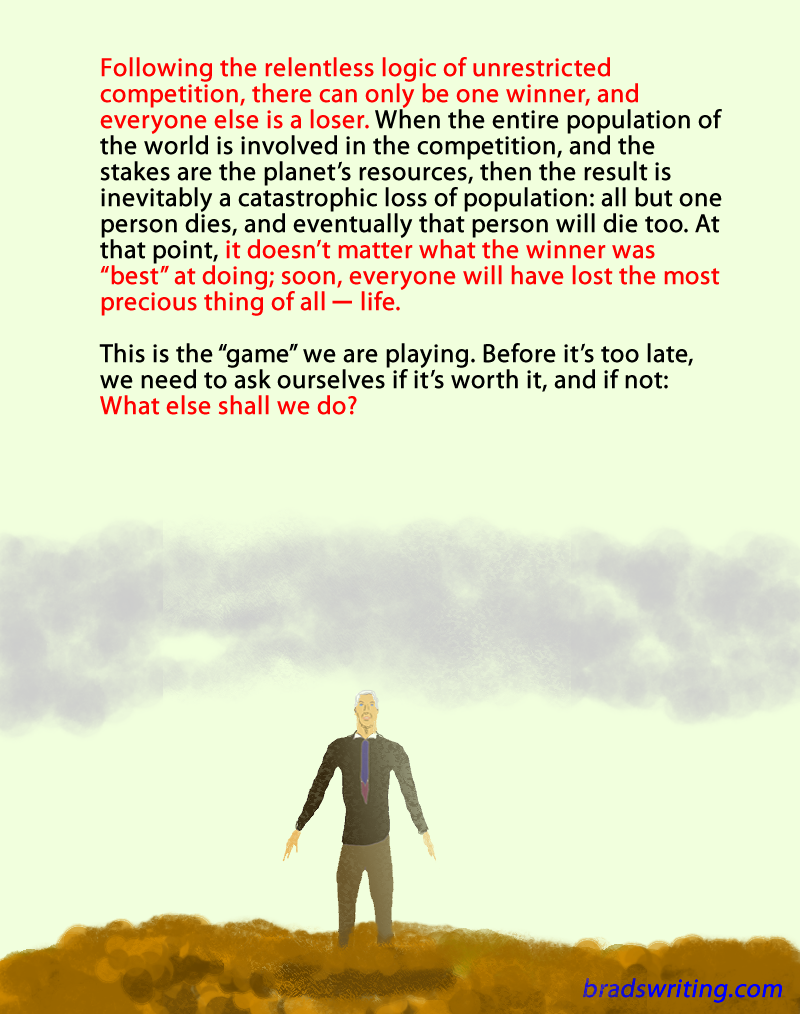
As a recent report highlights, our economic system rewards those who speculate, and victimizes those who work. It is also a global Ponzi scheme that threatens not only the economic wellbeing of the majority but availability of physical resources all of us depend on for survival. Essentially, we are participating in a game that cannot, nor should be, won. As I explained in a new meme, that game ─ unrestricted competition ─ can only result in the death of everyone.

I have detailed in multiple blog posts (and the upcoming book, Death Stoppers Anthology) my personal struggle with the inherent conflict between personal and global responsibility that we now face because of our proximity to global ecological limits. I shared it, along with evidence of that conflict, to be part of a conversation about how to create a future that maximizes our ability to survive and thrive as a species, and to be part of a team dedicated to realizing that future regardless of the personal consequences.

The competition that threatens us is not totally unrestricted yet, but the few who have the upper hand in that competition are focused on removing what few restrictions remain. This is especially obvious in the subversion of the U.S. political system, which made major gains in the recent mid-term elections in large part due to the weaponization of money enabled by a Supreme Court that values unrestricted competition. In a critical time when the world must be setting the stage for rapidly reducing carbon emissions (along with other stresses on Earth's life support systems), the social infrastructure dedicated to protecting common resources needed for our survival has become at-best useless, and at-worst is being co-opted to remove existing protections and make the situation much, much worse.

Many of us are held in thrall by the hope that we might still live comfortably following a life of service to the system we've been taught to believe is a legitimate source of value to the world, but in fact is dedicated to sucking us dry, just like the other "resources" that supply our pursuit of happiness as embodied by monetary wealth. For those of us who perceive the threat to our existence and that of future generations, this misperception and the hope it fuels must be replaced with a more accurate and comprehensive vision of real value that our lives can attain: a legacy that is testimony to whatever good remains in us, that is physically embodied by a better chance for the survival of our species. We must also share this vision with as many people as possible, and build up a critical mass of support so we might succeed despite the huge odds aligned against us.

Saturday, October 22, 2011

Blaming the Victims


I first became aware of the blaming-the-victims strategy for avoiding responsibility soon after Hurricane Katrina when an ultra-conservative friend of mine went on a rant about why his tax dollars shouldn't be used to provide disaster relief or repair the levees that had flooded the city of New Orleans. He argued that the residents of the area had known for a long time about the dangers, and foolishly chosen to live in an area that lower than sea level. Clearly, it was their fault, and they were so stupid that they wanted to rebuild their city and take the chance of the same thing happening again. Why should the rest of us have to pay for their mistakes?

In 2008, as the housing bubble was collapsing, this same friend meticulously collected “evidence” from a number of dubious sources, “proving” the cause was Clinton-era policies that enabled greedy, stupid, poor people to get mortgages they knew they couldn't afford. If they lost their homes, they deserved to. It was – and is – a common assessment by many on the political right.

The last straw for my friend was the possibility that a black, former community organizer (who by definition was in favor of the pernicious giveaway mentality of the political left) could become president. When Barack Obama won the election, undeserving people might get much more of his money, and the new president would have to be impeached. It was the last time we would speak, because, after years of tolerance, I had come to loathe the idea that some people's lives are more valuable than the lives of others, and to believe that we must take responsibility for harming others, whether directly or indirectly (such as through neglect).

Blaming people for their condition is a justification for neglect. It also permits us to harm people without internal deterrent, just like a person with a sociopathic personality disorder. It has enabled the concentration of political and economic power in the hands of a few people who were neither inclined, nor capable, of using that power to stop huge population loss, and might even favor it as a logical consequence of their competitive ethos. This, for me, is the ultimate evil.

When we refuse to help others, or harm them either directly or indirectly, we not only allow or increase the amount of pain and death in the world, we potentially harm ourselves because we can't learn what they might teach us. I've written about the blind spots we all have, which both endanger us and keep us from becoming aware of opportunities to increase happiness. Others can potentially see things we can't, and vice-versa; so working together is the best chance we have to improve our visibility. In addition, collective efforts at exploration can help us learn about things we don't currently see, and move together toward opportunity and away from danger that may be right over the horizon.    

Wednesday, March 9, 2011

Green Filter

Yesterday I was reintroduced to our society's version of a “green economy” while attending a training session sponsored by my county's main workforce center. While it was really just a plug for a local community college, it reminded me why I've shied away from enthusiastically seeking a job in the field: the green economy, as presently defined and practiced, isn't likely to significantly improve our chances of avoiding the global catastrophe I see lurking in the near future.

There's a popular expression, which I hate, that pops into my head when I write things like that: “Don't let the perfect be enemy of the good.” Sure, green jobs aren't going to solve all our problems, but they're better than what we're doing now – or so the logic goes. That's like saying, using my Titanic analogy, that turning the ship so it hits the iceberg at a slightly different angle is better than turning the ship so far that the passengers think you aren't taking them to their destination (assuming we can even do so, and in enough time to avoid impact). Sorry, but maybe perfect is what we need right now, along with a lot more lifeboats.

When I got home from the “training” I got a call from a recruiter about a contract-to-hire position as a technical writer, the transitional career I've been in since the late 1990s. It was a not-so-subtle reminder that cash is running out, and to use another expression I hate, “Beggars can't be choosers.” As idealistic as I am, as committed to trying to fix whatever I can, homelessness is not an option I'm willing to consider, especially since I'm not alone in this. If I get a chance to interview with an organization that isn't full-bore trying to kill the planet (involved in oil, global finance, war-making, or supporting right-wing politics, for example), I'll probably take it, and figure out how to use the job to do more good than bad.

In the mean time, I'll continue to use each new experience to narrow my search for what I want to spend most of my time doing. What I've learned so far is that I want to focus on increasing biodiversity, or at least curbing its loss. The key to this is the famous HIPPO acronym that I learned about by reading E. O. Wilson's work, which nicely summarizes the negative human impacts on other species. I've generalized this in my concept of consumption, which is proportional to the global ecological footprint. Reduce the footprint, and we can increase biodiversity; it's that simple. The big problem I've grappled with, of course, is the possible (and I consider likely) loss of human population that would accompany it, which appears to only be solvable by increasing the planet's natural carrying capacity (its “natural capacity”), or, more simply, the amount of other life. What this would practically translate into is the subject of my ongoing work (er, hobby) of defining an “ideal world.” From a career-search perspective, it confirms my inclination to move toward anything involving ecology, such as ecology with a conservation focus, human ecology, or social ecology.